Fovea puts one word on screen and pins its optimal recognition point, the letter at which a word is recognised fastest, to the same spot every time. What holds that point still is the layout: every word is positioned around that letter rather than centred. The colour only shows you where the point is. We have no evidence that colouring it helps you read.

Rich Dad Poor Dad
Summary
Rich Dad Poor Dad
An original summary of the book by Robert T. Kiyosaki, written from scratch for Fovea.
- Business
- Subject
- ~6k
- Words, typically
- 24.0 min
- At 300 words a minute
- EN, FR
- Read in either language
Summaries come with Fovea Pro. Importing and reading your own books is free forever.
Read the opening
The first 8.4% of this summary, free.
No account, nothing to sign. The whole thing is in the app, and every summary there is open to everyone.
When I was nine I asked my dad how to get rich, and the answer I got set me running on a wheel I would spend years learning to step off. I grew up with two fathers. My real dad was the most educated man I knew, the superintendent of schools for Hawaii, and he was broke his whole life. My best friend's dad never finished the eighth grade, and he built an empire.
The educated one stayed poor. The unschooled one got rich. That gap is the whole book, and it is not about how much they earned. It is about how they thought.
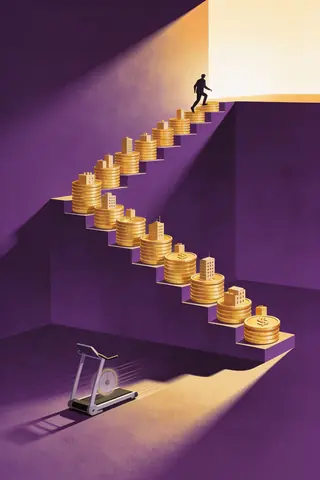
Here is the thesis, plain. The poor and the middle class work for money. The rich make money work for them. Most people, even smart, hardworking people, get a job, take the paycheck, pay the bills, and go back for more.
The raise comes, the spending grows to match it, and they run faster while staying in the same spot. That cycle is the Rat Race, and almost everyone is on it. What gets you off is not a bigger salary. A bigger salary on the Rat Race just buys fancier ways to stay stuck.
What gets you off is financial literacy and the mindset behind it. So learn the one distinction that decides everything: an asset puts money in your pocket, a liability takes it out. The rich quietly buy assets, the rentals and businesses and dividends that pay them whether or not they show up. The rest of us buy liabilities we have been told are assets, the house that drains us, the car that sinks in value, the doodads bought to look successful.
Mind your own business, which means feed your own asset column, not just your boss's. Raise your financial IQ until reading numbers and spotting opportunity becomes second nature. And beat the fears and lazy habits that talk you out of starting. If you do one thing, do this: pay yourself first.
The moment money lands in your hand, before a single bill, move some into an asset that earns. Think of each dollar as a worker you have hired, one that clocks in while you sleep and never asks for a raise. Do it when it is easy and do it when it is tight, because the squeeze sharpens you. Every dollar you touch is a choice between wealth and the Rat Race.
Your strongest asset is not your paycheck. It is your mind, and the choice is always yours.

7 more ideas in Rich Dad Poor Dad, waiting in the app.
- Two Dads, Two Mindsets
- The Rich Don't Work for Money
- Assets vs Liabilities
- Mind Your Own Business
- Financial IQ, Taxes, and Corporations
- Invent Money, and Work to Learn
- Overcoming Obstacles and Getting Started
Be clear about this
This is a summary. It is not the book.
Fovea wrote this summary of Rich Dad Poor Dad independently and from scratch, in our own words. We do not reproduce, abridge or excerpt Rich Dad Poor Dad. A summary carries the ideas and the argument, not the sentences that expressed them, and it runs at roughly a sixth of the length of the book behind it.
It is not written by, affiliated with, or endorsed by Robert T. Kiyosaki or the publisher. The title and the author are named here for identification only, and the cover art is generated for Fovea rather than taken from the book’s real jacket.
If you want the actual book, buy it, then import it into Fovea and read it here for nothing. That will never be behind a subscription.
How long it takes
A Fovea summary runs about 6,000 words. Read with the pacing the app actually uses, the median one in the catalog takes:
- 24.0min
- 300 words a minute, the speed the app starts you on
- 18.1min
- 400 words a minute, a comfortable working pace
- 16.1min
- 450 words a minute, about where a typical summary here gives out
- 10.5min
- 700 words a minute, past the point where comprehension holds
These are medians across the catalog, not this title’s exact figure, and they are measured rather than calculated: the gap between words is not constant, so words divided by speed gives a number the reader never produces. The last row is there for honesty, not as a recommendation. Comprehension gives out somewhere around 350 to 500 words a minute, and where exactly is a property of the text, not of the app.
How you read it: one word, one fixed letter.
Moving your eyes is not where reading time goes. A jump takes 20 to 40 milliseconds against the 200 to 250 of the fixation after it, so it is about a tenth of the total. Fovea takes back that tenth and the work of finding the next line. It does not make you read several times faster, and anyone promising that is selling you something.
Roughly one eye movement in seven goes backwards, and stopping readers from looking back measurably costs comprehension. So going back is not buried in a menu. Let go and the stream stops, tap the left edge to step back, swipe to scrub word by word or sentence by sentence, and switch to the paginated view to sit with a passage the ordinary way.