Skip to content
fovea

Sapiens

Summary

Sapiens

An original summary of the book by Yuval Noah Harari, written from scratch for Fovea.

Science
Subject
~6k
Words, typically
24.0 min
At 300 words a minute
EN, FR
Read in either language

Summaries come with Fovea Pro. Importing and reading your own books is free forever.

Read the opening

The first 3.8% of this summary, free.

No account, nothing to sign. The whole thing is in the app, and every summary there is open to everyone.

Seventy thousand years ago you would have had no reason to bet on us. Homo sapiens was a forgettable African ape, lodged in the anxious middle of the food chain, eating the marrow that bigger killers left behind. We were not the strongest, the fastest, or the cleverest of the human species then alive, and at least six kinds of human walked the Earth. Yet today one of those species owns the planet, has split the atom, decoded the genome, and reached for the keys to life itself, while the rest survive only as a faint smear of DNA in our blood.

The puzzle of this book is simple to state and unsettling to answer. How did so unremarkable an animal come to rule everything? The answer is not sharper claws or bigger muscles. It is a single, strange talent: the ability to cooperate flexibly, in vast numbers, with total strangers, by believing together in things that exist only in our shared imagination.

Gods, nations, money, laws, human rights, limited liability companies, none of these is found in any river or forest. They live in the collective mind, and yet they bind millions into common purpose, and that is the most powerful force our species ever discovered. A chimpanzee will never sacrifice a banana for the promise of reward in chimpanzee heaven. We will die for a flag, fund a hospital for a god, and trust a stranger because a coin in his hand carries a story we both believe.

These shared fictions are not lies. They are imagined orders, real in their effects precisely because so many of us agree to act as if they are true. Three revolutions carried this story forward. The Cognitive Revolution, around seventy thousand years ago, rewired our language so that we could speak of things that do not exist and so weave the myths that let strangers act as one.

The Agricultural Revolution, around twelve thousand years ago, chained us to wheat and rice and multiplied our numbers while making most individual lives harder, history's biggest fraud. The Scientific Revolution, some five hundred years ago, began with a humble and explosive confession, that we do not know, and married curiosity to empire and capital into runaway power. Each revolution multiplied what our species could do. None of them, as far as anyone can measure, made the average human any happier, because contentment tracks not our conditions but the gap between conditions and expectations, and that gap we keep widening.

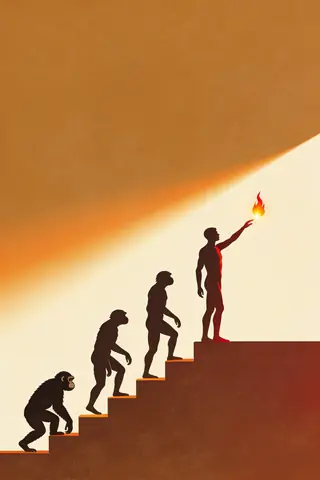
This is the single most important realization the long view forces upon us: power and happiness do not rise together. We have grown, in a geological eyeblink, from creatures who cracked bones at the edge of the kill into creatures on the verge of redesigning life through genetic engineering, cyborgs, and artificial minds. We are becoming gods. And the final, vertiginous fact is that we have acquired godlike power without acquiring godlike wisdom or even clear desire.

We can do almost anything, and we do not know what we want. Having mastered our environment and terrorized our fellow creatures, we remain dissatisfied and dangerous, sailing fast toward a horizon no one has charted. Is there anything more perilous than a discontented god who does not know what he is for?

7 more ideas in Sapiens, waiting in the app.

  • An Animal of No Significance
  • The Cognitive Revolution
  • The Agricultural Revolution
  • The Unification of Humankind
  • The Scientific Revolution
  • Capitalism and the Industrial Age
  • Happiness and the Future of Sapiens
Get early accessOn the App Store soon.

Be clear about this

This is a summary. It is not the book.

Fovea wrote this summary of Sapiens independently and from scratch, in our own words. We do not reproduce, abridge or excerpt Sapiens. A summary carries the ideas and the argument, not the sentences that expressed them, and it runs at roughly a sixth of the length of the book behind it.

It is not written by, affiliated with, or endorsed by Yuval Noah Harari or the publisher. The title and the author are named here for identification only, and the cover art is generated for Fovea rather than taken from the book’s real jacket.

If you want the actual book, buy it, then import it into Fovea and read it here for nothing. That will never be behind a subscription.

How long it takes

A Fovea summary runs about 6,000 words. Read with the pacing the app actually uses, the median one in the catalog takes:

24.0min
300 words a minute, the speed the app starts you on
18.1min
400 words a minute, a comfortable working pace
16.1min
450 words a minute, about where a typical summary here gives out
10.5min
700 words a minute, past the point where comprehension holds

These are medians across the catalog, not this title’s exact figure, and they are measured rather than calculated: the gap between words is not constant, so words divided by speed gives a number the reader never produces. The last row is there for honesty, not as a recommendation. Comprehension gives out somewhere around 350 to 500 words a minute, and where exactly is a property of the text, not of the app.

How you read it: one word, one fixed letter.

The fixed point

Fovea puts one word on screen and pins its optimal recognition point, the letter at which a word is recognised fastest, to the same spot every time. What holds that point still is the layout: every word is positioned around that letter rather than centred. The colour only shows you where the point is. We have no evidence that colouring it helps you read.

What it actually saves

Moving your eyes is not where reading time goes. A jump takes 20 to 40 milliseconds against the 200 to 250 of the fixation after it, so it is about a tenth of the total. Fovea takes back that tenth and the work of finding the next line. It does not make you read several times faster, and anyone promising that is selling you something.

Going back

Roughly one eye movement in seven goes backwards, and stopping readers from looking back measurably costs comprehension. So going back is not buried in a menu. Let go and the stream stops, tap the left edge to step back, swipe to scrub word by word or sentence by sentence, and switch to the paginated view to sit with a passage the ordinary way.

More in Science

See all